
Mission-Ready Infrastructure, Part 1: Delivering Capability at the Speed of Relevance

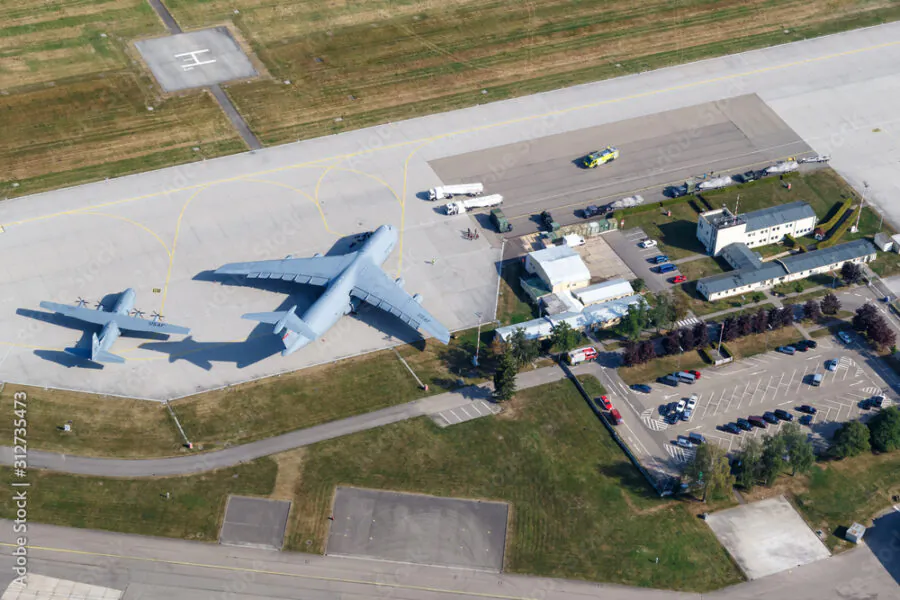
An aircraft flares for landing in the pre-dawn hours, returning safely to its installation after executing a mission hundreds, or perhaps thousands, of miles away.
To most observers, the aircraft is the weapon system. It is the visible platform that executed the mission, delivered the intended effect, and returned home. Yet the successful mission began long before the aircraft reached its objective.
Hours before takeoff, maintainers prepared the aircraft in specialized facilities powered by resilient utility systems. Fuel was stored, distributed, and delivered. Munitions were received, secured, assembled, and loaded. Mission planners relied on secure facilities, communications networks, and information systems to prepare crews and coordinate operations. As the aircraft taxied for departure, airfield pavements, lighting systems, navigational aids, and airfield operations personnel worked together to move the platform safely from the apron to the runway to execute its mission.
The same infrastructure that enabled the aircraft to depart now supports its return, recovery, maintenance, refueling, and preparation for the next mission.
If any one of those systems fails, the aircraft itself may remain fully mission capable…this time. A degraded fuel system, aging utility network, inadequate maintenance facility, compromised communications system, or deteriorated airfield pavement can reduce an installation’s ability to generate operational capability long before operations stop entirely.
Military leaders routinely assess the readiness of aircraft, ships, vehicles, and combat systems by evaluating the systems that enable them to operate. The same principle applies to military installations. Readiness depends not on a single component but on the system’s performance when called upon.
The aircraft may be the visible weapon system. The installation generates the capability.
If that premise holds, infrastructure must be delivered, modernized, and sustained with the same urgency as the missions it supports. Military installations are being asked to support more complex missions, advanced technologies, and rapidly evolving operational requirements while operating under significant time, resource, and workforce constraints.
As a result, the Department of War is increasingly adopting new approaches to infrastructure delivery. Collaborative delivery, digital integration, converged physical and cybersecurity planning, workforce augmentation, and portfolio-based investment strategies help owners deliver mission capability faster, reduce risk, and improve readiness.
Delivering Infrastructure at the Speed of Mission Relevance
If installations generate capability, infrastructure investments become readiness decisions rather than facilities decisions, and the Department of War (DOW) does not lack infrastructure requirements. It lacks the time, funding flexibility, workforce capacity, and execution resources to address every requirement simultaneously. As a result, infrastructure prioritization is not simply an administrative exercise. Leaders must balance mission risk, operational disruption, schedule certainty, lifecycle cost, appropriations constraints, and the realities of executing projects on active installations.
The most consequential investments are not always the most visible. An airfield recapitalization project that increases sortie generation may provide greater operational value than a new administrative facility, yet both may be needed. A utility modernization effort that preserves command continuity may reduce more mission risk than replacing a facility. Investments in resilient power, water, communications, and secure digital environments often affect multiple mission systems at once.
The challenge facing military infrastructure leaders is not simply building faster. It is reducing the time between identifying a mission need and delivering the capability required to support it.
That pressure is driving one of the most significant changes in DOW infrastructure delivery: a shift away from sequential project-development models and toward greater collaboration among owners, designers, and builders.
Collaborative Delivery Moves Capability Forward Faster
For years, DOW project delivery emphasized procedural compliance, risk mitigation, and technical completeness. Those priorities remain important, but the balance is changing. Traditional delivery approaches often struggle to keep pace with mission demands, particularly when requirements continue to evolve while projects are still being planned, funded, designed, or awarded. That shift was made explicit in the April memorandum, Accelerating Delivery of Infrastructure to the Warfighter, “Effective immediately, DOW will cease reliance on obsolete methods of acquisition and construction and fully embrace these new authorities to accelerate infrastructure delivery.” The memo makes clear that this shift “is not optional; it is a mandate for immediate and comprehensive implementation.”
Collaborative delivery approaches, including Design-Build, Progressive Design-Build, CMGC, CMAR, and Early Contractor Involvement, bring owners, designers, and builders together earlier in the process. While the delivery methods differ, they share a common principle: success depends on collaboration. Effective collaboration is more than meeting earlier. It requires owners, designers, and builders to develop a shared understanding of mission requirements, project objectives, risks, constraints, and what success ultimately looks like. The most successful teams align around the capability being delivered rather than each organization’s individual responsibilities.
The objective is not faster design or faster construction. The true objective is to deliver mission capability faster.
When teams establish that shared understanding early, they can make better decisions, identify risks sooner, resolve constructability issues before they become problems, and make informed tradeoffs when mission needs, budgets, schedules, and operational constraints inevitably compete.
Collaborative delivery is not a shortcut, however. Speed without alignment simply becomes rework. The most valuable partners will understand the owner’s mission, challenge assumptions early, surface constructability and security constraints before award, and help maintain focus on the desired operational outcome throughout delivery.
Digital Delivery Enables Better Decisions
Collaboration only works when project teams can quickly understand problems, evaluate alternatives, and make informed decisions. Digital delivery is increasingly making that possible.
The Department of War has no shortage of data. Installations generate information about facilities, utilities, pavements, energy systems, communications networks, maintenance requirements, asset condition, and project performance. The challenge is turning that data into information that improves decision quality.
Modern digital delivery tools help bridge that gap. Shared models, reality capture, common data environments, digital engineering, and digital twins let owners, designers, and builders visualize projects earlier, evaluate options faster, and better understand the consequences of key decisions before committing resources.
The value extends beyond design and construction. Digital delivery gives installation leaders a clearer understanding of how infrastructure systems interact, how missions depend on them, and where future investments will have the greatest impact. That information supports everything from project execution to asset management, master planning, and infrastructure recapitalization.
As the Department continues to embrace Operational Master Planning, digital delivery provides a powerful way to connect mission requirements to infrastructure investments. Rather than evaluating facilities as individual assets, leaders can better understand dependencies across the installation, identify capability gaps, and prioritize investments based on operational outcomes. More importantly, digital delivery creates a common operating picture that lets owners, designers, builders, operators, and planners work from the same information and align on the same objectives.
Digital delivery is not about creating more data. It is about creating better information.
Organizations that can transform infrastructure data into decision-quality information will be better positioned to prioritize investments, manage risk, accelerate delivery, and improve mission readiness.
From Faster Delivery to Lasting Readiness
Delivering mission-ready infrastructure requires more than accelerating design or construction. It requires earlier alignment, collaborative decision-making, and reliable information that helps owners, designers, and builders understand mission needs and resolve risks before they affect delivery.
But speed is only part of the readiness equation. Infrastructure must also remain secure, resilient, and capable of supporting the mission through disruption.
In Part 2, we explore how military infrastructure leaders can connect security and resilience to mission assurance, move from individual project lists to mission-focused portfolios, and build the organizational capacity required to turn infrastructure plans into operational capability.
Related Insights
Explore how mission assurance, strategic investment and workforce capacity can help military installations reduce risk and strengthen readiness.
Rich Stump, AIA, LEED AP BD+C, talks through the latest developments and challenges shaping today's federal infrastructure projects.
After dedicating more than 30 years to the United States Air Force, Scott Grainger, PE, PMP, understands the true weight of federal missions.

Tara Pence has quickly progressed from a go-to project planner to a trusted project manager, leading complex planning efforts at Minot Air Force Base and Peterson Space Force Base with excellence.