A Project Spotlight on Keeping Van Nuys Moving
How Strategic Construction Phasing, Safety, and Stakeholder Trust Delivered a Complex Airfield Transformation
Upgrading critical taxiways at one of the world’s busiest general aviation airports required careful planning, strong collaboration, and constant attention to construction safety. At Van Nuys Airport, RS&H delivered the upgrades while minimizing operational disruptions.
In the heart of the San Fernando Valley, Van Nuys Airport serves as an aviation hub for corporate and charter flights, flight training, and emergency services. The airport serves a diverse mix of customers who rely on continuous access at one of the world’s busiest general aviation airports.
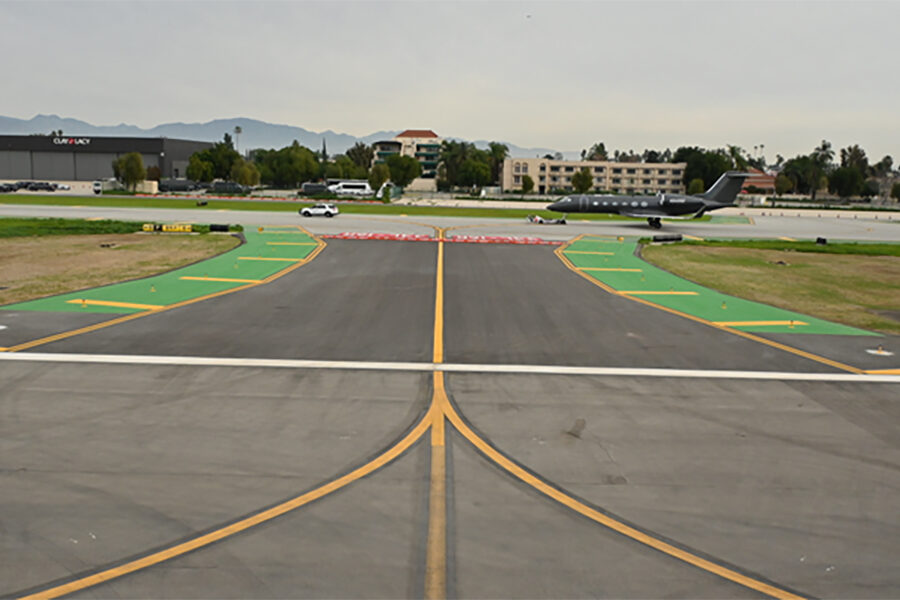
Launched in 2023 and advancing multi-year construction in 2026, RS&H partnered with the airport through its Airfield Improvement Program to deliver upgrades at the core of daily operations. At the center of the effort was the need to fully reconstruct 11 connector taxiways serving the primary runway, aging pavements whose condition and location posed growing operational and safety challenges. This work required extensive construction efforts in close coordination with airport stakeholders, allowing daily operations to continue while minimizing disruptions and maintaining safety, operations, and tenant trust.
The project team rebuilt the taxiways through thoughtful design, collaborative decision‑making, and disciplined construction safety and phasing, keeping a critical airport operational and customers moving during a complex airfield transformation.
Rebuilding the Airfield While Keeping Flights Moving
As RS&H’s first major airfield design effort at Van Nuys Airport, the project required the team to take on some of the airfield’s most complex and high‑impact work. Design decisions focused on delivering taxiways capable of withstanding continuous operations while fitting seamlessly into a highly active airfield. The airport has already invested in pavement improvements across the airfield. However, what proved most challenging were the connector taxiways linking aircraft movement areas directly to the main runway. Each taxiway required full‑depth reconstruction, with pavement sections reaching approximately two feet deep. In several areas, poor underlying soils required deeper excavation and replacement, which added complexity to an already complex scope.
Did you know? With a multi-year phased construction approach, early planning allowed the airport to continue advancing the priority improvements without delay, even when funding constraints emerged late in the design phase.
The team began with thorough pavement evaluations, combining visual inspections by RS&H airfield engineers with geotechnical testing support. Taxiways were ranked by condition, frequency of use, and location. This prioritization gave the project team and airport stakeholders a clear basis to decide which taxiways to address first, where funding would deliver the greatest benefit, and how to manage airport operations most effectively.
Unlike previous improvements at the airport, construction would directly affect runway availability and daily operations. Due to funding, the project was strategically divided into two bid packages. Early evaluations helped identify which taxiways were both aging and most critical to daily operations. Year One focused on taxiways that could be reconstructed while maintaining runway operations through carefully planned runway shortenings. Year Two addressed the taxiways located toward the middle of the runway, which required full runway closures. During both years, the first phase of the projects focused on less critical operational areas for the contractor to gain familiarity before moving into the more critical operational taxiways in the middle portion of the runway.
A defining feature of the project was how runway closures were planned and executed. Traditional night‑only construction windows were evaluated and ruled out due to safety risks, quality concerns, and inefficiencies associated with short shifts.
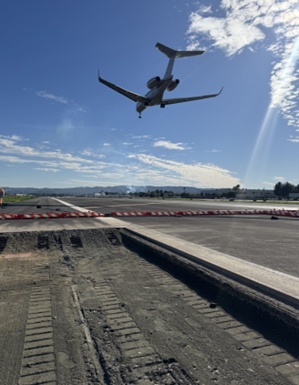 Instead, the project team collaborated closely with airport operations, the FAA tower, and airport tenants to implement a series of planned 80‑hour runway closures. These closures ran from late Sunday night through early Thursday morning, preserving weekend access when tenant demand was highest. Over six such closures, four of the most integral taxiways were fully reconstructed. While the idea initially met resistance, workshops and transparent communication helped stakeholders gain a clear understanding of the trade‑offs involved, including safer pavements, improved airfield lighting, and a more reliable airport for years to come. Some operators temporarily relocated aircraft to nearby airports during closure windows, demonstrating the level of coordination and trust built throughout the process. This approach reduced construction risk, improved quality control, and minimized the total number of disruptions compared to prolonged night-only work.
Project Tip – Uncomfortable operational decisions become manageable when stakeholders are invited into the solution, not informed after the fact.
Using Data and Safety to Choose the Right Path Forward
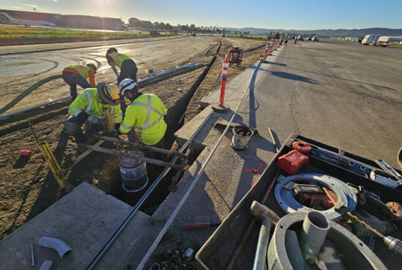 Safety shaped every phase of the work, from planning through construction. Formal Safety Risk Management panels were conducted for both bid packages. These panels evaluated construction phasing, runway closures, and temporary configurations to ensure risks were identified and mitigated before work began. Construction planning also emphasized safety and reliability by incorporating on‑site staging and material stockpiles. This reduced dependence on off‑airport suppliers and surrounding roadways, helping contractors stay productive within tightly constrained work windows.
Constructability was a primary consideration throughout the design process. Pavement sections were intentionally standardized, and materials were simplified to enable contractors to work more efficiently. The design was optimized to strike a balance between constructability and cost, ensuring funding goals were met while maintaining buildability, quality, and schedule certainty, an approach that was especially important during the limited closure periods. This strategy was particularly valuable in complex areas, such as the taxiway reconstructed directly above the Sherman Way tunnel, where close coordination with structural engineers was necessary to protect the underlying infrastructure.
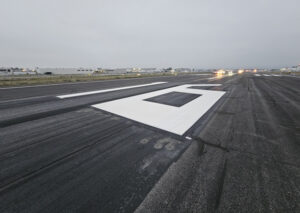 As the project team learned through the taxiway reconstruction, proactive communication moved the project from start to finish. A dedicated project website provided up‑to‑date information on construction progress, runway closures, and schedule changes. When weather required adjustments (such as shifting an 80‑hour closure due to heavy rain), the website allowed the team to quickly inform tenants and the public, reinforcing trust and transparency.
The Van Nuys Airport Airfield Improvement Program shows what’s possible when the most operationally sensitive projects can succeed when engineering excellence is paired with meaningful stakeholder engagement. Runway closures may be inconvenient for tenants, but once they understood what they would gain in the end, we were able to move forward together.
By pairing thoughtful phasing, safety‑driven planning, and constructable design with consistent stakeholder engagement, the team delivered critical infrastructure upgrades while keeping one of the world’s busiest general aviation airports moving. The result is a stronger, safer airfield that supports Van Nuys Airport’s operations for years to come.
Related Insights
John Lengel Jr., PE, ENV SP, Vice President and National Discipline Leader at RS&H, received the 2026 Florida Airports Council J. Bryan Cooper Vision Award. The award recognizes his leadership and lasting contributions to aviation environmental stewardship, sustainability, and resilience.
Mike Rudzinski, AIA, NCARB, explores the trends shaping the next generation of airports, from smarter wayfinding and wellness-focused spaces to advanced air mobility, and how innovative terminal design is creating better passenger experiences.
Growing in Lafayette, RS&H combines local connection with national expertise—supporting the community through partnerships, student engagement, and transformative work at Lafayette Regional Airport.
We are proud to partner with TPA to design solutions and plan spaces that further enhance their already award-winning passenger experience.