
From Blueprint to BIM: 3D Models as Legal Documents
Transportation leaders today face a critical choice: continue relying on two-dimensional plans that breed risk and inefficiency, or embrace a digital transformation that unlocks unprecedented precision and value. The gap between these two paths is widening. Sticking with traditional 2D contract documents exposes agencies to the persistent threats of interpretation errors, costly change orders, and schedule overruns. The alternative is to adopt Model as a Legal Document (MALD) and 3D deliverables, which are no longer experiments. It is a strategic imperative.
This is not about adopting technology for its own sake; it’s about redefining how we build the future of public infrastructure with accountability and purpose. Agencies that hesitate will soon find themselves at a competitive disadvantage, struggling to meet new standards and deliver the value taxpayers demand. The time for deliberation is over. The digital mandate is here, and leaders must decide whether to guide their organizations into the future or be left behind.

The Bare Minimum: Crafting 2D Plans from 3D Models
Current software, such as Bentley’s OpenRoads Designer or Autodesk’s Civil 3D, requires designers to build 3D models to provide cross-sections for traditional 2D plans. This effort provides many benefits over traditional 2D workflows, but when the model is not submitted as a 3D deliverable, it is often only developed enough to make the signed and sealed cross sections look good. In that case, it’s only reliable every 50 or 100 feet. Even if a rudimentary 3D model is passed on to the contractor, they may not be able to use it for automated machine guidance. With only 2D plans to work from, contractors are forced to spend time creating or recreating 3D models that designers are better qualified to build.
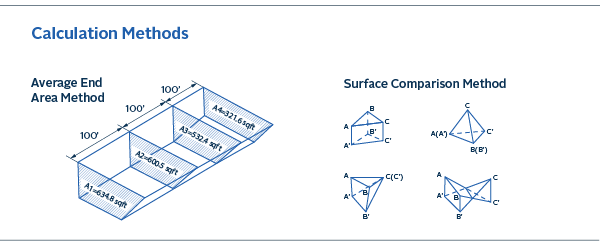
Some workflows, even with newer software, still rely on average end-area volumes rather than on surface-to-surface comparisons enabled by 3D models. By their nature, average end-area volumes derived from cross-sections are inaccurate, assuming no significant changes between sections and calculating volumes on curves as if a roadway were straight. Surface-to-surface comparisons use a computationally¹ intensive method that divides the volume into prisms and calculates the volume of each prism to determine the volume between the two surfaces.
Validating Model as a Legal Document ROI on the Central Segment of the First Coast Expressway
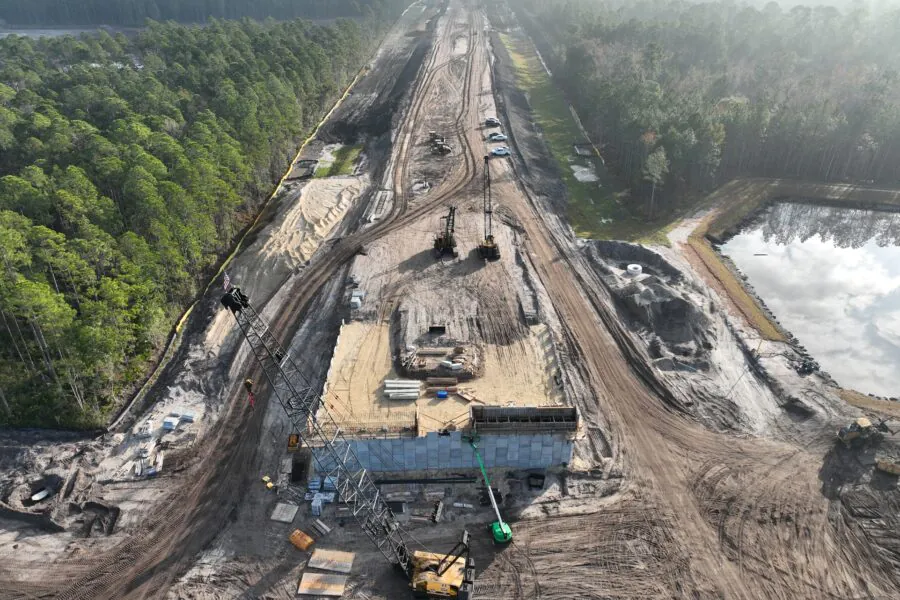
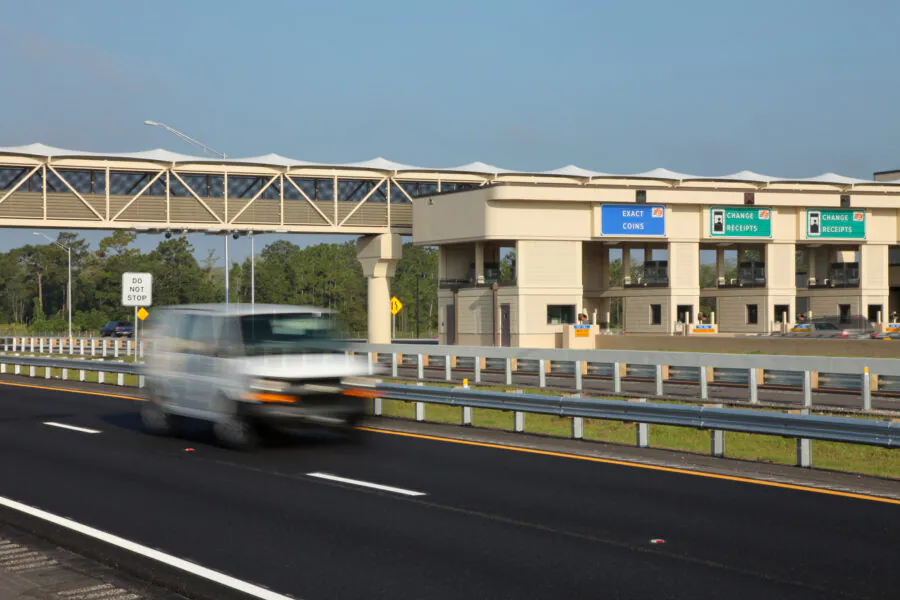
Skepticism of new standards is natural, but the evidence in favor of MALD is now undeniable. Consider the central St. John’s County segment of the First Coast Expressway in Jacksonville, Florida, a $242 million greenfield highway construction project. Facing a compressed 12-month design schedule, the project served as a high-stakes proving ground for the real-world return on investment of a 3D-centric approach.
The results speak for themselves. The project team, a collaboration of five firms, navigated complex earthwork, new construction, and resurfacing with a level of coordination that would have been impossible with 2D plans.
- Precision Under Pressure: By treating 3D models as the single source of truth, teams eliminated the ambiguities that cause field discrepancies. Every discipline, from structures to drainage, worked from identical, legally binding data.
- Proactive Problem Solving: Design conflicts were identified and resolved virtually, long before they could become costly change orders during construction. Including the 3D model in the quality control process helped identify many issues that would have been missed by merely reviewing plan sets alone. Modeling drainage networks and existing utilities in 3D enabled clash detection of utility conflicts and sufficient pipe cover beneath changing roadway and embankment surfaces. This “digital rehearsal” de-risked the entire project delivery process.
- Enhanced Collaboration: Siloed teams transformed into an integrated unit. Structural engineers modeled bridges that directly informed the grading surfaces for civil teams, creating a seamless workflow that accelerated progress and improved quality. The team was also able to check vertical clearance and ensure smooth transitions of the roadway surface at the approach slabs.
- Accurate Quantities: Modeling surfaces for existing subgrade, proposed subgrade, subsoil excavation, and surcharge embankment allowed for detailed quantity calculation for budget estimates. Signing and sealing these surfaces allowed the contractor to obtain the same quantities in the bid process, with both the designer and the contractor using surface-to-surface volume calculations.

The central segment of the First Coast Expressway is a clear validation of the business case for MALD. It demonstrates that investing in digital delivery generates measurable returns in risk reduction, efficiency, and project certainty.

A Decision Framework for Leveraging Model as a Legal Document
For state agency directors and executives, the transition to MALD is a strategic decision that extends far beyond technical implementation. It is about redefining how an organization manages risk, fosters collaboration, and builds infrastructure with a long-term vision in mind. Adopting a systematic framework ensures this transition aligns with your highest strategic priorities.
1. Prioritize Based on Risk Mitigation
The first step is to identify which project elements pose the greatest risk. Instead of a blanket mandate, apply a risk-based lens to determine which 3D deliverables should be legally binding.
- Focus on Complexity: Mandate signed and sealed models for elements with complex geometries or critical safety implications, where misinterpretation of 2D plans could have severe consequences.
- Target High-Cost Components: Prioritize deliverables that directly influence major cost centers, such as earthwork, subsoil excavation, and structural components. Precise digital quantities reduce budget overruns.
2. Mandate True Multidisciplinary Coordination
Digital delivery is a catalyst for breaking down silos. Your role as a leader is to champion a culture of shared ownership over the integrated model.
- Establish Data Accountability: Require each discipline to take ownership of its respective 3D models. This ensures that subject matter experts are accountable for the accuracy of their data.
- Optimize for the End User: Insist that design deliverables are created in formats optimized for construction and asset management software. The model’s value is only fully realized when it seamlessly transitions from design to construction and into operations.
3. Build for Long-Term Asset Management
The benefits of MALD do not end when construction is complete. A legally binding 3D model is the foundation of a digital twin—a dynamic virtual representation of a physical asset.
- Plan for the Digital Twin: Frame the initial 3D model as the first step in your long-term asset management strategy. Handing off a 3D model to construction opens the door for 3D as-builts as well. This as-built digital record is invaluable for future maintenance, upgrades, and operational planning.
- Leverage Lifecycle Data: An accurate digital model enables predictive maintenance, optimizes operational efficiency, and provides a clear and accessible record for future projects, saving your agency significant time and resources over the asset’s lifespan

The National Call to Action: Lead or Be Left Behind
The Florida Department of Transportation’s move to require MALD is not an isolated event. They are early leaders in a national shift. As more states recognize the overwhelming benefits of digital delivery, these requirements will become the standard rather than the exception. The question for every transportation leader is simple: Will you lead this transformation, or will you be forced to react to it?
Leading means proactively investing in people, processes, and technology to build this capability within your organization. It means championing a culture of innovation and holding your teams accountable for delivering a higher standard of excellence. It means building partnerships with firms that have proven expertise and can guide you through this transition.

Waiting, on the other hand, means accepting a future where your agency is less competitive, your projects are riskier, and your infrastructure is more costly to build and maintain. It means watching other states set the agenda and, eventually, having to adopt their standards from a position of disadvantage.
The path forward is clear. The evidence is compelling. The tools and expertise are available. The future of infrastructure is digital, precise, and collaborative. Together, we have the opportunity to build a better, more resilient, and more connected tomorrow. The time to lead is now.
Ready to take the next step? RS&H is here to help.
1 Image sources: Cheng, Jian-chuan, and Long-jian Jiang. “Accuracy Comparison of Roadway Earthwork Computation between 3D and 2D Methods.” Procedia – Social and Behavioral Sciences, Intelligent and Integrated Sustainable Multimodal Transportation Systems Proceedings from the 13th COTA International Conference of Transportation Professionals (CICTP2013), 96 (November 6, 2013): 1277–85.
josebchl. “Average End Areas Method Example.” Batista Land Surveyor, October 9, 2016.
Related Insights
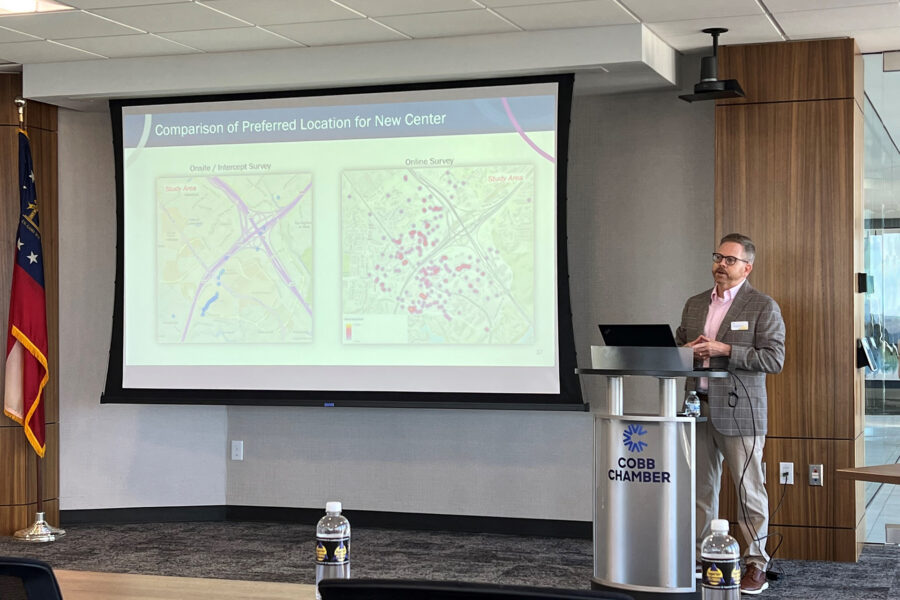
RS&H has been named a 2026 American Council of Engineering Companies (ACEC) Georgia Engineering Excellence Merit Award, recognizing the firm's exceptional work on the Cumberland Transit Center Site Feasibility Study for the Cobb County Department of Transportation (DOT).
In this episode of AEC Perspectives, host Rachel Moore joins RS&H’s National Bridge Inspection and Preservation Leader, Corey Rogers, PE, and In-Service Bridge Inspector, Scott Brown, to explore how unmanned aerial systems are revolutionizing infrastructure maintenance.
The financial and operational success of tolling infrastructure hinges on addressing one critical challenge: commercial leakage.
These accolades underscore RS&H’s dedication to partnering with clients to create innovative, impactful solutions that enhance communities and set new industry standards.